

English
pick up
政治
政策提言
“Japan eyes changing prostitution law to punish sex buyers”: AFP Features Survivors and Colabo Founder Yumeno Nito: AFP Features Survivors and Colabo Founder Yumeno Nito
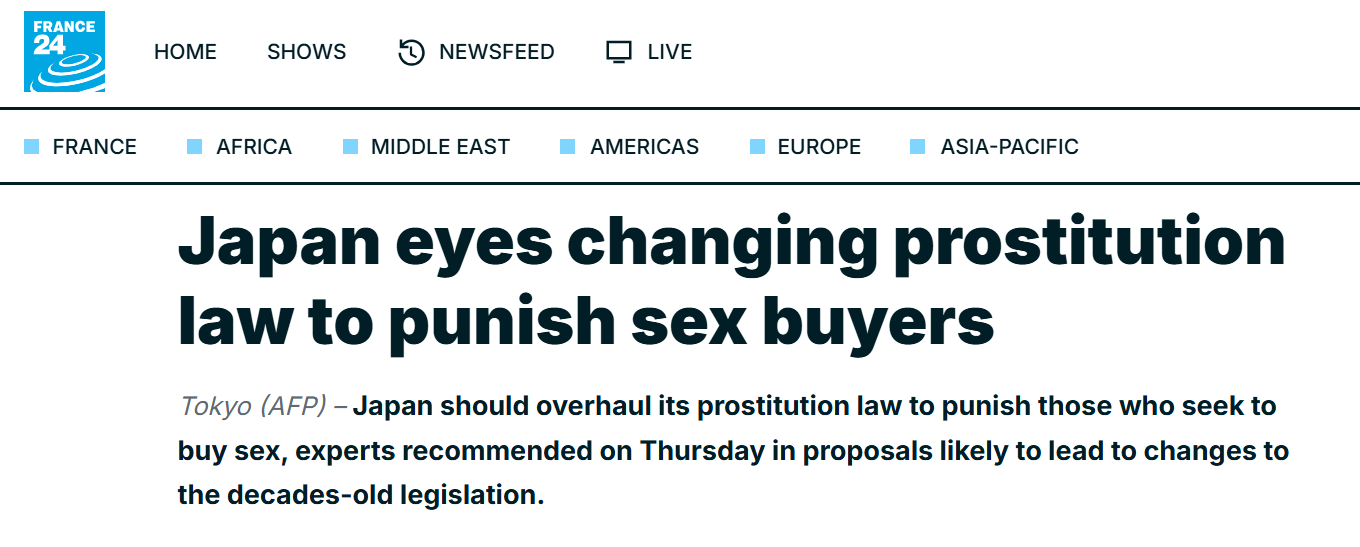
The article highlights the current imbalance in Japan’s legal system: women who solicit buyers on the street can be punished, while those who buy sex face no penalties. The panel proposed introducing penalties for certain acts by buyers, including solicitation in public spaces and online. However, it did not recommend decriminalizing those who sell sex.
The article also features the voices of members of Toka (“Light”), a group of survivors of the sex trade.
Risa, a member of Toka, spoke about the consequences of continuing to punish those who sell sex:
“they won't be able to report violence and other terrible experiences to police, for fear of being labelled criminals”
Risa also described how, in her twenties, she believed she was acting voluntarily while trying to survive multiple difficulties in her life. She told AFP:
“I had to act like a doll, switch off all emotions and pretend to be pleased no matter what was done to me.”
The article also introduces Nao, a member of Toka who fled abuse by her mother and lived under a bridge from the age of 14. She turned to street prostitution to survive each day. Looking back on her experience, she said:
“But now I know I was a victim of sexual exploitation.”
AFP also interviewed Yumeno Nito, founder of Colabo. Nito pointed out that even if women move from the streets into the indoor sex industry, this does not mean that they have broken free from the sex industry.
Drawing on examples from South Korea, she called for publicly funded, specialized support for women who need help, including support that enables them to build new lives after leaving prostitution.
The AFP article closes with Nito’s comment:
“Examples overseas teach us that if there is support and a system in place, women can have and choose from a range of options and live their lives accordingly.”
The AFP article has been published by news outlets in several countries, including The Japan Times in Japan, CNA (Channel NewsAsia) and The Straits Times in Singapore, and the Namibia Press Agency (NAMPA).
【Media Coverage】
■ France 24 (France)
https://www.france24.com/en/live-news/20260917-japan-eyes-changing-prostitution-law-to-punish-sex-buyers
■ The Japan Times (Japan)
https://www.thejapantimes.jp/Economy/732672-japan-eyes-changing-prostitution-law-to-punish-sex-buyers.html
■ CNA (Channel NewsAsia) (Singapore)
https://www.channelnewsasia.com/east-asia/japan-change-prostitution-law-punish-sex-work-buyers-6391581
■ The Straits Times (Singapore)
https://www.straitstimes.com/asia/east-asia/japan-eyes-changing-prostitution-law-to-punish-sex-buyers
■ NAMPA (Namibia Press Agency) (Namibia)
「女性人権センター」建設プロジェクト
社会からの攻撃・妨害に屈しないための女性運動の拠点「女性人権センター」を建設します。
2030年の完成を目指し、現在寄付キャンペーンをおこなっています。「女性人権センター」設立に力を貸してください








SUPPORT
共に声を上げ、
社会を変える
仲間になりませんか
少女たちを追い詰める社会構造を変えるため、共に声を上げ、共に闘う仲間を募集しています。
